

Phurba — Himalayan power object
Great Mother House · 26 September 2026
For centuries, triangular, carved blades known as *kīla* or *phurba* have been widely used in the shamanic and tantric cultures of the Far East during magical rituals. Infused with mantras and elemental energy, in the hands of local sorcerers and priests, they became powerful transformers of energy, employed in diverse forms of healing, exorcism, the removal of obstacles, and the pacification of turbulent forces. Yet, these were no ordinary ritual tools; their very form—three sides converging at a single point—embodied a cosmology: the union of heaven, earth, and the underworld within a single object that could be driven into any space, transforming it into the center of the world.
Practices involving the phurba form the foundation for the development of most Tibetan tantric systems. In the hands of an experienced adept, the phurba becomes not merely a tool but a vehicle of consciousness—one that allows for ascent into other worlds and enables the recognition of one’s own nature as the wrathful power of compassion.
The Phurba (Tibetan: *phur ba*; Sanskrit: *kīla*) is a peg, stake, or nail—something driven in to immobilize. The root *kīl-* signifies “to bind, fasten, attach, or pin down.”
The Phurba does not cut like a sword; instead, it drives into a specific point, stabilizing it and pinning the obstacle in place so it can no longer act. The *Kīla* binds and immobilizes. The Sanskrit *kīlaya* can even carry an imperative sense—”fasten! pin down! immobilize!”—whereby the name of the deity and the gesture of the instrument become one.
In the phurba, all the layers of the Himalayan spiritual tradition meet: Indian tantra, Vajrayana Buddhism, Tibetan bön, and the shamanism of the Nepalese jhankri. The core of the tradition — kīla — is of Indian origin, but in Tibet and Nepal it was interwoven with local rites of the earth, the spirits of place, and protective deities. Before it became a tool of tantra, however, it was something more primal and more powerful: a stake driven into the ground.
The tent peg, the nail of heaven
The origin of the phurba is the interpenetration of the mystical and shamanic traditions of India, Nepal, and Tibet. The oldest layer is nomadic. The tent peg did more than fasten the tent — it restrained the evil forces capable of disrupting the nomads’ lives and their ritual occupation, the hunt. Some Nepalese phurbas of iron or bronze bear the traces of this function physically: split or twisted pommels from hammer blows, driven into the ground for good.
The same archetype lives on in the names of the stars. The Samoyeds call the Pole Star the “nail of heaven” — the peg fastening the celestial tent to the firmament. Among the Altai Tatars, the Buryats, and the Soyots, the tent peg was identified with the pillar of the heavens. The nomad pitching camp repeated a cosmic gesture: he drove in a small axis mundi, which for one night turned the flat steppe into the center of the universe.
In India, the idea of the stake reached its most perfect form in the yūpa — the ritual sacrificial post, which was at once the axis joining the earth to the world of the gods, the point of sacrifice, and the boundary of sacred space. Three functions the phurba took over directly: axis, sacrifice, boundary. A description of an old house-building rite survives: before the first stone was laid, the builder pinned with a peg of khadira wood the head of the world-bearing serpent — and the cornerstone was set directly above that point, in the very center of the world. This gesture re-enacted the primordial victory of Indra, who with his vajra shattered the skull of Vritra — the serpent who had stolen the waters of the world — and returned the rain to the earth.
This myth literally lives inside the phurba: at the base of the blade sits the makara — the watery monster insatiably swallowing the waters of the four oceans — and above it rises the vajra. The structure of the phurba is a miniature of Indra’s victory: the vajra above the serpent’s jaws, the rod of rain above the abyss of waters, light pinned to a single point above the darkness. No accident, then, that the phurba has always served in rain rituals.
Three faces converging on one point
The classic phurba divides into three levels — the pommel, the shaft, and the blade — and each of these in turn tends to be threefold. The pommel most often shows the three faces of Vajrakīlaya: joyful, peaceful, and wrathful — three countenances of one wisdom. The blade is triangular: three faces converging in a single point. The three faces pin to that point the three poisons of the mind — ignorance, craving, and aversion: the forces that keep a human being scattered, gathered by a single stroke into one.
In its shamanic reading, the phurba is a map of the journey through the three worlds:
Bird (Garuda) — heaven · Face of the shaman — the human world · Tiger — the wild border · Makara — the threshold of the waters · Nāga — the underworld · Blade — the deepest point, driven into the earth.
Hence the words of the Nepalese shamans: “Without the phurba within himself, the shaman has no consciousness. The shaman himself is the phurba — he takes on its form in order to fly into other worlds.” The phurba is not a tool for the journey — it is the vehicle: the axis, the world tree in miniature. The very types of phurba confirm this: the sa-phur — the “nail of the earth” — driven literally into the ground, in rites of subduing the earth and marking the boundaries of sacred space; and the guru phurba — a shorter one, with which the shaman-master directs the spirits during the journey through the three worlds. Standing upright in a basket of rice, it simply is the axis of the world.
Three circles of practice
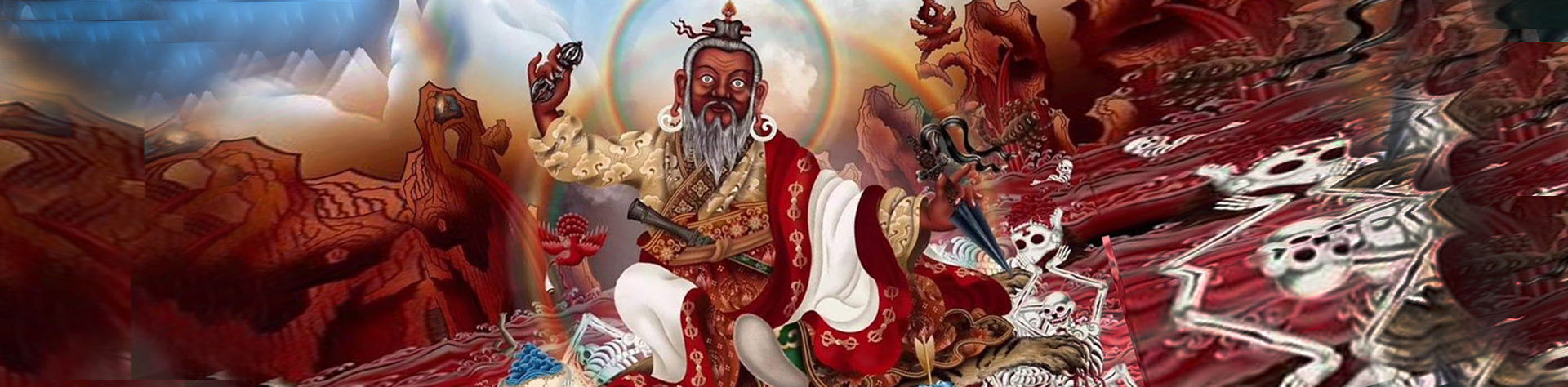
The lama uses the phurba as Vajrakīlaya — the wrathful form of Vajrasattva, a wrath born of compassion. He pierces with it the symbolic figures of obstacles, not destroying the energy but freeing it: the transfixed consciousness is directed toward liberation. In a world where the suppression of natural forces breeds the dark, hungry underworlds of the collective unconscious, Vajrakīlaya represents the courage of confronting what has been repressed. He does not flee from the darkness — he pierces it, recognizes it, and transforms it into wisdom. After consecration the phurba ceases to be an object: it becomes a living form of the deity. In the hands of a practitioner — it is himself as Vajrakīlaya.
The jhankri — the Nepalese shaman — dances with the phurba in trance, pointing with the blade the paths his incantations follow. His dhyangro drum has a handle shaped like a phurba: the form of the kīla has grown into the very center of the shamanic instrumentarium. A young jhankri often carves his own phurba after initiation, in accordance with the dream in which he sees the tree from which it is to be made — the instrument is born from a vision, like the shaman’s path. In healing rites he touches with the triangular blade the place in the body where the suffering resides: the illness is located, pinned down, and drawn out. And when the sick one cannot be touched with the blade, he dips the tip of the phurba into water — and gives the charged water as medicine. The phurba is the axis along which the shaman himself ascends and descends between the worlds: as a bird he soars to heaven, as a predator he crosses the wild border, as a serpent he descends for the soul of the sick.
The priest of Bhairava — the Newari gubaju of the Kathmandu Valley — works with the wildest aspect of Shiva: Bhairava, who does not suppress the darkness — he is the darkness awakened to consciousness. The gubaju uses a Bhairab kīla with a single head and a double vajra: a mirror in which he recognizes himself as the deity. One face, one vajra, one gaze. He heals by stirring water with the phurba while mantras are recited; he cleanses houses and spaces. His practice, though rooted in the tantra of Shiva, is structurally identical to the lamaist one — in Kathmandu the boundaries are fluid, and phurbas travel between traditions.
Sacred union
The deepest nature of the phurba is phallic: the kīla is a lingam — an instrument of divine Shiva which, like a pestle in a mortar, strikes the vessel of feminine space and shatters the compacted accumulations: karmic deposits, the traces of wounds, fears, and aggressions. The ritual strike of the kīla is a grinding of karma: what is hard and old is broken into powder, in which the primal, pure nature of the energy can at last be recognized. The freed energy returns to the space from which everything comes and to which everything returns.
All of reality manifests through the polarization of opposites — light and darkness, consciousness and space. Consciousness — light, attention, presence — penetrates and impregnates the cosmic womb of space, the living matrix from which all life is born. The makara receives the pillar of the vajra as the yoni receives the lingam: the structure of the phurba is the structure of the sacred pair — vajra in makara, light in darkness, consciousness in space. Liberation never happens through one of the opposites, only through their fusion. Every use of the phurba shares the structure of sacred union: conscious presence enters what is dark and chaotic — not to defeat it, but to awaken it and dissolve it. The phurba is a union sealed inside the form of an instrument — which is why it should always stand vertically, point down, in the position of the lingam ready to descend. Driven into the earth, into rice, into water — everywhere it does the same: it consecrates the place through union, dissolving in the cosmic womb all that is hard and separate, until nothing remains but pure space and light.
The spectrum of action
In practice, the scope of the phurba’s action extends across all planes of reality—from the outermost to the innermost. Yet all of these involve, in essence, a related technique—a gesture repeated at various levels. The phurba immobilizes what is chaotic, anchors what is scattered, and liberates what is trapped in a regressive form.
Outwardly, the phurba orders the world: it removes the obstacles that block the path, disarms the forces that breed chaos, closes and stabilizes the sacred space, purifies the ground before anything new is raised upon it, and reaches to where the weather lives — into the realms of the nāgas and the waters from which the rain is born. In each of these acts it acts in the same way: it does not push the chaos beyond a boundary, nor drive it out to do harm elsewhere. It pins it in place, and then orders the space around the axis it itself has become in the moment of striking. That is why a boundary drawn by the phurba is not a wall — it is the center of the world, from which everything takes its order.
Deeper down, the phurba works with living forces: with the spirits of the earth, which are not driven out but subdued and, by oath, woven into the geometry of the sacred space — enemies are made into protectors, for in the logic of tantra nothing is wasted, and no energy is evil in itself. And deeper still — with the beings that directly interfere: it transforms them not through destruction, but through liberation. The piercing of the symbolic figure of the obstacle is an act that from the outside looks like violence, yet is in essence mercy performed with surgical precision: the grace that remains for a being that can no longer receive grace in any other form.
And at the very end, the phurba turns toward that from which everything began — toward the practitioner’s own mind. The ultimate “demon” pinned by the kīla is the ego, attachment, and dualistic consciousness: the three poisons that the three faces of the blade drive into a single point, where they dissolve into emptiness. Hence its epithet: the “Diamond Dagger of Emptiness.” There is no demon outside. There is only the mind that must be grounded in the space of its own nature — and all the outward ritual dramaturgy: demons, figures, the dance of wrath — is a theater in which the mind stages its own masks, only in order to pierce them and recognize itself within them.
And finally, working with one’s own mind — for the ultimate “demon” pinned by the phurba is the ego, attachment, and dualistic consciousness. Hence its epithet: the “Diamond Dagger of Emptiness.” There is no demon outside. There is only the mind that must be grounded in the space of its own nature — and all the outward ritual dramaturgy: demons, figures, the dance of wrath — is a theater in which the mind stages its own masks, only in order to pierce them and recognize itself within them.